
Beyond the Bottom Line
Manufacturing leaders have spent the last several years learning to operate under constant labor pressure. Teams are leaner. Production schedules are tighter. And many facilities now rely on temporary labor to help maintain output when demand changes or staffing gaps emerge.
But what happens when that temporary labor does not show?
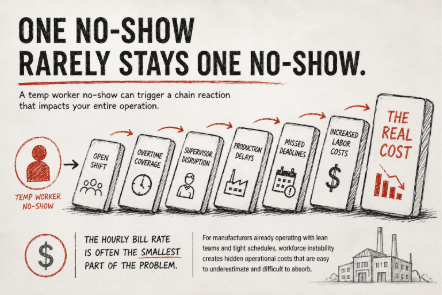
A temp worker no-show rarely stays contained to one shift. One missing worker can force a trickle effect that upsets the entire operation. One labor gap can touch nearly every department, resulting in a cost that stretches far beyond the hourly bill rate.
The Cost Starts Before Production Falls Behind
The first cost of a no-show is not lower output. It is disruption.
Before production slows, supervisors are already making calls. HR is looking for coverage. Team leads are adjusting assignments. Someone agrees (again) to work late.
None of that effort appears on a staffing invoice, but it consumes time, attention, and money.
In manufacturing, there is rarely excess capacity built into the day. U.S. production workers already average about four hours of overtime each week, a sign of how tightly many facilities are staffed. When one person is missing, the burden does not stay in one place; it shifts across the operation.
The immediate problem is not just the absence itself, but the additional overtime costs and production disruption that follows. The larger cost is the management effort and mental load of coordination that are required to absorb it.
Temporary Labor Should Reduce Pressure
One of the main reasons manufacturers use temporary labor is for flexibility. Operationally there are many variables at play and temporary staffing should help navigate those variables rather than hinder them.
When temporary staffing becomes unpredictable, the strain starts well before a shift begins. A staffing request goes out, workers are assigned, and by the next morning supervisors are left wondering who will actually show up. Coverage gaps create last-minute scrambling, production schedules become harder to maintain, and HR teams, staffing partners, and frontline leaders often find themselves solving the same problem at the same time. As no-shows, turnover, and inconsistent attendance continue, staffing stops serving as a solution and starts creating additional operational challenges.
WAE was designed to help employers fill shifts quickly with workers who have demonstrated reliability and a proven history of showing up. By combining workforce management with real-time technology, WAE gives manufacturers immediate access to available talent while providing greater visibility, automation, and centralized oversight across their staffing operations. The result is faster coverage, stronger attendance, and fewer disruptions on the production floor. Because for manufacturers, success is not measured by how many workers are assigned. It is measured by keeping production running.
The Hidden Costs
The reality is most manufacturers expect some level of overtime. Having experienced employees absorbing the gap may feel manageable at first, however, when overtime becomes the backup plan for unreliable staffing, the cost compounds.
Long hours increase fatigue; tired workers increase safety risks and lost productivity. This leads to morale erosion and rising turnover among those employees managers depend on the most.
The result is a hidden cost many manufacturers underestimate: paying more to sustain instability than it would cost to improve reliability.
Reliability Is an Operations Strategy
Manufacturing leaders routinely invest in equipment, logistics, and production systems to improve efficiency. Workforce reliability deserves the same level of attention.
That is why more employers are moving toward centralized workforce management instead of relying on multiple disconnected staffing vendors. When accountability is fragmented, attendance problems are harder to solve and communication becomes reactive. With centralized oversight, patterns become visible sooner, issues can be addressed faster, and preventable labor gaps are less likely to disrupt production.
For manufacturers, that means less time spent managing staffing uncertainty and more time focused on output.
Sources:
https://www.bls.gov/ces/data/employment-and-earnings/2024/table7b_202406.htm
https://themanufacturinginstitute.org/2-1-million-manufacturing-jobs-could-go-unfilled-by-2030-11330